Clienteling beyond luxury
The word was born in luxury and it is no longer confined there. Asked by the Comité Colbert, together with the MAD, which skill their sales teams most lack, 77% of the French maisons surveyed cite clienteling, well ahead of storytelling at 55%. That finding holds for fine jewellery and leather goods. It also describes, almost word for word, what retail leadership teams in home decoration, household equipment, optics, sport and selective beauty are saying today.
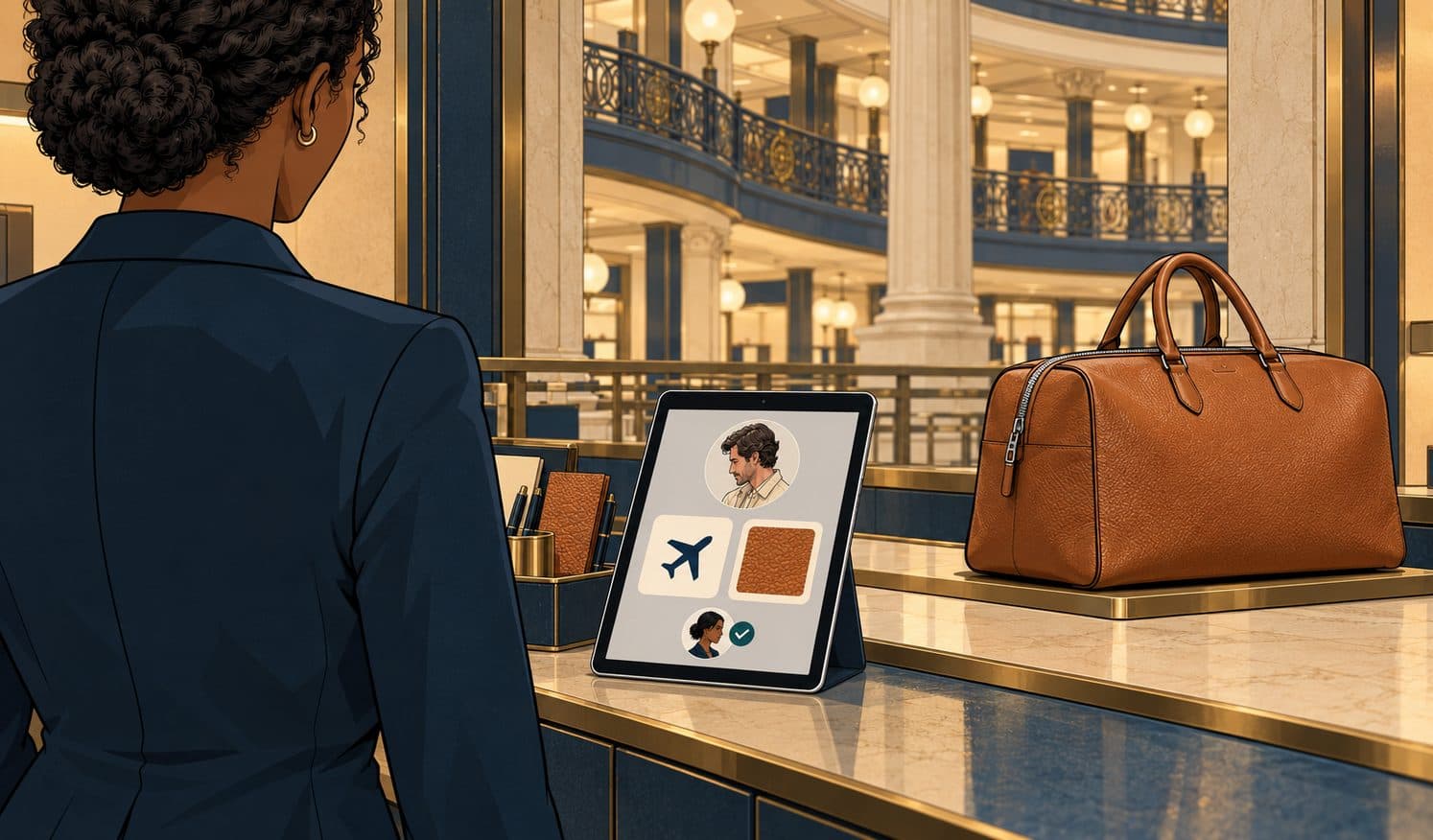
The shift is visible in organisation charts before it is visible in the talk. Specialist retail chains are recruiting in-store client relationship managers. Loyalty programmes that were nothing more than a points mechanism are becoming instruments of recognition. Networks of several hundred points of sale are asking their teams to hold a continuing conversation with clients they used to see only at the till.
The question is therefore no longer whether clienteling is moving out of luxury. It is what transposes, what does not, and what that changes for the training of the teams.
What did luxury formalise before the rest of retail?
Luxury did not invent personalised client relationships. Local shopkeepers have always practised them, and the bookseller who sets a title aside is doing clienteling without the name.
What luxury did was formalise it. It turned a shopkeeper's intuition into a documented discipline: a method for qualifying, a discipline of note-taking, a rhythm for making contact again, rules about what is noted and what is not, a way of welcoming somebody whose story you already know without letting them feel it.
That formalisation is precisely what travels. A furnishing chain has no reason to copy the welcome protocol of a jewellery maison, but it has every interest in recovering the method that structures that protocol.
Two reasons explain the head start. The first has to do with the basket: when a sale represents several thousand euros, an hour spent with a client is economically justified, and the maison can afford to write down how it wants that hour to be conducted. The second has to do with the network: as soon as a brand operates boutiques across thirty markets, it can no longer rely on a team's oral culture to hold a standard. It has to write it down, then transmit it. The rest of retail is arriving at that second point today without having arrived by way of the first, which explains why it is taking up the method but not the format.
Three real differences, which should not be smoothed away
Transposing without adapting is the surest way to make the whole approach feel artificial. Three structural gaps count.
Purchase frequency. A fine jewellery client returns rarely and her journey stretches over years. A household equipment client returns often, sometimes for small amounts, with projects that have a beginning and an end: a move, a child's bedroom, a terrace. Clienteling there follows a project rather than a collection.
The basket and the time available. An advisor can devote an hour to a client in a fashion boutique that receives a few dozen visits a day. She has far less of it in a store that receives several hundred on a Saturday. Personalisation therefore has to fit into three minutes, which is not a degraded version of clienteling but a different exercise.
The density of footfall. In a department store or a sales floor of several thousand square metres, a client is not systematically taken in hand. The skill is not only to receive somebody well: it is to spot, within a continuous flow, the visit that deserves to be stopped for.
Those three gaps do not call the discipline into question. They determine the format in which it is exercised.
What Maisons du Monde shows about client loyalty
The training games designed for Maisons du Monde show how a mainstream retail chain installs relational skills, client loyalty first among them, across an entire network. It is the only mainstream retail case in the portfolio, and that is what makes it transposable here: neither the basket, nor the time per client, nor the density of footfall resembles that of a maison.
Three projects coexist. A change-management game, "Déco Challenge", built around the five Cs. An eight-minute game devoted to the loyalty programme, deployed to 1,600 retail staff. A game on diversity and inclusion, designed for the Engagement Week. More than 8,000 people have been reached.
The second project is the one that concerns our subject most directly. A loyalty programme is the most common point of entry for clienteling in mainstream retail: it is through the programme that the store earns the right to recognise a client, to keep a history and to make contact again. It is also the most fragile link. A loyalty programme is conceived by a central team, carefully documented, then entrusted to thousands of people who attended none of those meetings and who have to explain it in thirty seconds, standing up, to a client in a hurry.
What this project shows is that a relational mechanism takes hold through practice rather than through the internal memo. An eight-minute sequence the team actually plays transforms what is said on the shop floor more than a reference document left in a shared folder. The clienteling skill is built in the same way: by repeating a situation, not by reading a method.
What changes when clienteling strategies are transposed
Taking clienteling out of luxury shifts three pedagogical parameters.
The first is volume. A maison trains a few hundred advisors across markets it controls. A mainstream chain trains several thousand, in franchised or integrated stores, with faster team turnover, a constraint set out in onboarding across a franchise network. A programme that presupposes a room and a trainer will never reach the whole network before its composition has changed.
The second is useful duration. On a dense sales floor, the training time available is counted in minutes taken between two shifts. The format has to bend to that: short sequences, replayable, accessible on mobile.
The third is legitimacy. In luxury, a continuing relationship is part of the implicit contract. Elsewhere, an advisor who reminds a client what he bought six months earlier must first establish that the approach is a service and not a sales chase. That boundary is worked on through concrete cases, never in a charter.
That is what our personalised client relationship programmes cover, and their mechanics rest on situations to be settled rather than on content to be worked through.
Where to begin when you are not a luxury maison
Begin with the right to recognise. Without a client base that is fed, there is no clienteling, only good selling. The loyalty programme, the card, the online account are the ways in, and explaining them in store is a training subject in its own right.
Then choose two moments, not ten. The first contact with an identified client and renewed contact after purchase are enough to create a visible effect. A store manager who tries to install eight gestures at once obtains none of them.
Finally, fix what you will observe before launching anything: the proportion of visits attached to a known client, the return rate of clients contacted again, the share of the team genuinely active. Those indicators are worth more than a completion rate, which says only that the module was opened.
To go further, clienteling training sets out the skills expected of an advisor, clienteling tool adoption deals with the frequent case in which the technology is in place without being used, and the guide to cross-selling and up-selling takes up what a continuing relationship then allows you to propose.
Frequently asked questions
Does clienteling make sense in a high-footfall chain?
Yes, provided you give up applying it to everybody. In a high-footfall store, the skill consists of identifying the minority of visits that justify personalised attention, then conducting it properly. Clienteling applied indiscriminately to eight hundred visits a day is not demanding clienteling, it is a script.
Do you need dedicated software to begin?
No to start, yes to last. Many chains begin with the data from their loyalty programme and a disciplined use of the tools they already have. The software becomes indispensable when several stores have to share the same knowledge of a client. It never replaces the gesture: a tool that is available and not used is a very widespread case.
How do you personalise the client relationship without being intrusive?
By treating the boundary as an object of training. Teams need cases in which a piece of information is obviously useful, cases in which it is obviously out of place, and ambiguous cases that have to be settled. It is in settling those last ones that judgement is built, far more than in reading a rule.
What is clienteling, in concrete terms, in store?
It is the discipline of recognising a client from one visit to the next and drawing a continuing conversation out of it. In concrete terms it comes down to four gestures: retaining what will be of use again, writing it for a colleague as much as for yourself, choosing the right moment to make contact again, and finding a legitimate reason to do so.
The word was born in luxury, where the value of the basket and the size of the networks obliged the maisons to write down what local shopkeepers practised by intuition. It presupposes neither dedicated software nor a wealthy clientele: a furnishing, optics or selective beauty chain can exercise it from the data in its loyalty programme and a disciplined use of the tools it already owns.
What it is not: a points programme, a campaign of automated chasers, or a box to be filled in at the end of a sale. The difference lies in the fact that the gesture is decided by the person who saw the client, and not triggered by a calendar.
Your network is growing and the client relationship has to keep up? Request a demo